
You set up the challenge. You picked good dates, you named it something fun, you dropped the link in the group chat. And then: nothing. One person replied with a thumbs up and never joined. Everyone else scrolled past.
This is the most discouraging part of starting a group challenge, and it is almost never about your friends not caring. It is about how the ask was made. The good news is that the fixes are small. Who you ask, what you say, and when you send it matter far more than the challenge itself, and none of it requires being pushy.

Why invitations get ignored
Before the fixes, it helps to know what you are actually up against. Almost every ignored invite falls into one of four buckets, and none of them is "I do not want to."
- It went to everyone, so it went to no one. A message addressed to a group is a message nobody personally owns. Everyone assumes someone else will go first, and the invitation quietly dies waiting for a volunteer.
- They could not tell what they were signing up for. "Want to do a walking thing?" leaves your friend guessing at the time commitment, the difficulty, and whether they will be embarrassed. When people cannot picture the cost, they default to not replying.
- They think they are too slow, too busy, or too out of shape. This is the big silent objection in any fitness invitation, and nobody says it out loud. They just do not answer.
- They meant to and forgot. Genuinely the most common one. They read it while walking into a meeting, thought "yes, later," and later never came.
Notice that three of the four are fixed by wording and one is fixed by a follow-up. That is the whole guide.
Ask one person at a time
If you change only one thing, change this. Sending five individual messages beats one group message by a wide margin, every time.
A personal message does two things at once. It makes the invitation impossible to leave for someone else to answer, and it signals that you actually want that person there, rather than warm bodies for a leaderboard. It takes about four minutes to send five texts. It is the highest-value four minutes in the whole process.
Use the group chat afterward for momentum and updates, once a few people are already in. Group chats are great for "we just passed 50 miles." They are poor for recruiting.
Say why you thought of them
One specific sentence turns a broadcast into an invitation. You do not need to be sentimental about it. You just need to name the reason.
Same challenge, same link. The second one is addressed to a person.
Name the real cost, because they are overestimating it
Your friend is quietly running the numbers, and they are guessing high. They are picturing daily workouts, a schedule, and something they will fail at publicly by week two. Correct that before they have to ask.
Be concrete about three things: how long it lasts, what counts, and how much effort logging takes. "It runs for the month of August, any walk counts, and logging takes about five seconds" removes almost all of the imagined burden. Every vague word you cut makes a yes more likely.
Head off the "I would just be last" objection
This is the one nobody will tell you, so you have to answer it unprompted. Plenty of people skip fitness invitations purely because they assume they will be the slowest name on a public list.
Say the quiet part yourself: there is no pace requirement, a walk around the block counts the same as anyone else's, and the leaderboard is there for encouragement rather than ranking people by fitness. Lean on the goal, too. Everyone in the challenge aims at the same personal target, and everyone who reaches it earns a medal, so there is no single winner to lose to. "We are all going for 30 miles this month" is a much easier thing to join than something that sounds like a race.
Timing: send it right before it starts
Invitations sent two weeks ahead get filed under "later" and forgotten. Invitations sent the day before, or on day one, get acted on because there is a reason to act now.
A few timing rules that help:
- Send within a couple of days of the start. Close enough to feel real, with enough room to say yes.
- Send when people are on their phones. Early evening and weekend mornings beat the middle of a workday and beat late at night, when your message gets buried by morning.
- Do not wait for a perfect roster. Start with whoever is in. A challenge already in motion is far more attractive to join than a challenge that has not begun.
Follow up once, without apologizing
Most people who do not join never actually decided not to. They forgot. A single, cheerful follow-up two or three days later recovers a real share of them, and it is not nagging.
The trick is to make the follow-up carry news rather than repeat the ask. Give them something new to react to.
Progress is the pitch. "We are already at 40 miles" says this is real, it is working, and there are people in it. That is much more persuasive than the original invitation was.
Make joining take one tap
Every extra step between "yes" and "in" costs you people. Send the join link itself rather than telling someone to go find the app and look for your challenge.
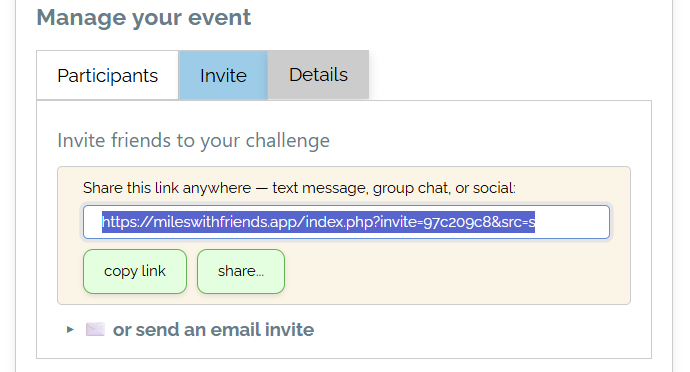
On Miles With Friends, open the Invite tab on your event and you will find your personal join link at the top. Copy it, or use the share button on your phone to send it straight into a text or chat. When your friend taps it, their invitation code is already filled in, so they set up a free account and land directly in your challenge. There is nothing for them to type and nothing to look up.
If you would rather use email, the same tab has a ready-to-send invitation with your challenge name and join code already built in, so you can add a personal line and send it.
Get them to their first mile within 48 hours
Joining is not the finish line. A friend who signs up but never logs anything usually drifts away within the week, and they are much harder to pull back than to nudge in the first place.
So treat the first logged mile as the real goal. A short message the next day does it: "log whatever you walked today, even if it is half a mile, it all counts." Once someone has logged once, they know how it works, they can see their name on the board, and they are far more likely to keep going.
For more on where challenges lose people after the start, read Why Most Friend Fitness Challenges Fizzle in the First Week.
Copy-and-paste templates
Adjust the details and send. These are starting points, not scripts, and they work better in your own voice.
Frequently asked questions
How many people should I invite?
Start with four or five people you would genuinely enjoy doing this with, and ask them individually. A small group that actually shows up is much better than a big list of maybes, and it is far easier to keep a small group moving.
What if nobody joins at all?
Start anyway, and log your own miles for a few days. It sounds counterintuitive, but a challenge with visible progress is much easier to recruit into than an empty one. Then follow up with your original list and lead with what you have done so far.
Is it rude to follow up?
One follow-up is welcome, especially when it carries news rather than repeating the ask. Most people are glad to be reminded of something they meant to do. If someone passes twice, let it go and keep the door open for the next one.
Can friends in other cities or countries join?
Yes. Everyone logs their own miles from wherever they are, so distance is not a barrier. Friends and family spread across different places can share the same challenge and the same leaderboard.
Is it free for the people I invite?
Yes. Creating an account, joining a challenge, and logging miles on Miles With Friends is free, so there is nothing standing between your friend and a yes.