

Yes, it is worth trying, and a few words is a fine place to start. A fitness journal is a short note you keep next to your exercise numbers, usually what you did and how it felt.
A note that short is easy to start, and on a day when you have more to say, you can write a page.
What should you write in a fitness journal?
Start with what you did and how it felt, then add anything that stood out, such as the route or something you want to try next time.
Distance and time belong in your log, but a sentence about the weather, the route or how your legs felt is easier to read back than to remember. Here are five made-up examples, from a good day to a day with almost nothing to report:
Flat day: Ran 2 miles. Heavy legs the whole way. Went anyway.
Skipped day: Did not go. Rain and a long day. Short walk tomorrow.
Short day: Ten minutes around the block between calls. Not much, but it happened.
No-numbers day: Rode with Sam. No idea how far. Good hills, good coffee afterward.
You can add numbers or leave them out. If you get stuck, finish a sentence that starts "Today felt" or "Next time I want to", and try writing it right after you log, while the day is fresh. On days when you have more to say, write more.
Is a fitness journal different from an exercise log?
An exercise log records the numbers, such as distance, time, sets and weight, and a journal is the note beside them. The two work well together, though plenty of people keep only the log.
If you lift and add weight or reps over time, the numbers matter more than the prose, so keep the log first. If you mostly walk, run or ride, a sentence about the day can say what the numbers leave out.
Should you keep a fitness journal at all?
You do not need a journal to exercise, but a short trial takes little effort if the idea appeals to you. The main thing a note adds is context. A slow walk on Tuesday is just a smaller number in a log, and a sentence tells you why it was slow. Over a few weeks you also build up something to read back.
The closest research covers tracking and walking. A review of 138 studies, mostly about personal health goals, found that people who monitored their progress were more likely to reach the goal. The effect was larger when they physically recorded their progress or reported it publicly. NIDDK, part of the US National Institutes of Health, includes a sample activity log with a How I Felt column. That shows one way to keep a log and is not evidence that it works. The CDC says regular walking can improve your mood and walking groups can help you remain socially connected. That is about walking and says nothing about writing. None of the research linked on this page tests a private fitness journal, so read it as background.
Most entries will be ordinary, and a journal will not get you out the door. The research above also does not show that writing about exercise changes your mood or how long you keep exercising, so whether a note makes any difference to you is something only a trial will show. If writing starts to feel like homework, shorten it or take a break.
What if you miss a day, or a week?
A journal has no streak to protect. If you miss a day, write the next entry when you are back, or fill in the missed day if you remember it, and the same goes for a missed week. Once in a while it can be worth reading the last few entries back, which takes about two minutes.
For a single missed day, habit research points the same way. In a 2010 study, 96 volunteers each picked an eating, drinking or activity habit. Among the volunteers whose data fit the model, the time for the habit to feel 95% as automatic as it would get ranged from 18 to 254 days. Missing one opportunity did not materially affect habit formation. The study was about habits, not journals.
Should a fitness journal be private?
Yes, it can be. A paper notebook stays private unless you hand it over. With an app, check who can see what you write and where it is stored. Some people want a place for notes they would never post, while others share on purpose. In a group challenge your miles are usually on a shared board, and a note beside them can stay yours.
Frequently asked questions
How long should a fitness journal entry be?
Start with a sentence or two. Write more on days you have more to say, and keep it short on days you do not.
Do I have to write every day?
No. Write when you have something to say or want a record of how a day felt. Some people write after every session, and others once a week.
Paper or an app?
Either works. Paper is easy to start and private by default, and an app is handy if you already log your numbers there. Pick the one you will actually open.
What if I only want to track numbers?
That is a complete exercise log in itself, and for some goals it suits better than prose does. Add a note on the days something stands out.
Is a fitness journal worth it for beginners?
It can be, since a beginner has no history to look back on and early notes start one. Numbers alone are a reasonable start as well, so skip the notes if they feel like a chore.
Can you keep a fitness journal in Miles With Friends?
Yes. Miles With Friends has a feature called My Journal. Under the ENTER YOUR MILES fields, tap or click Add a journal entry, write a few words, and log your miles as usual.
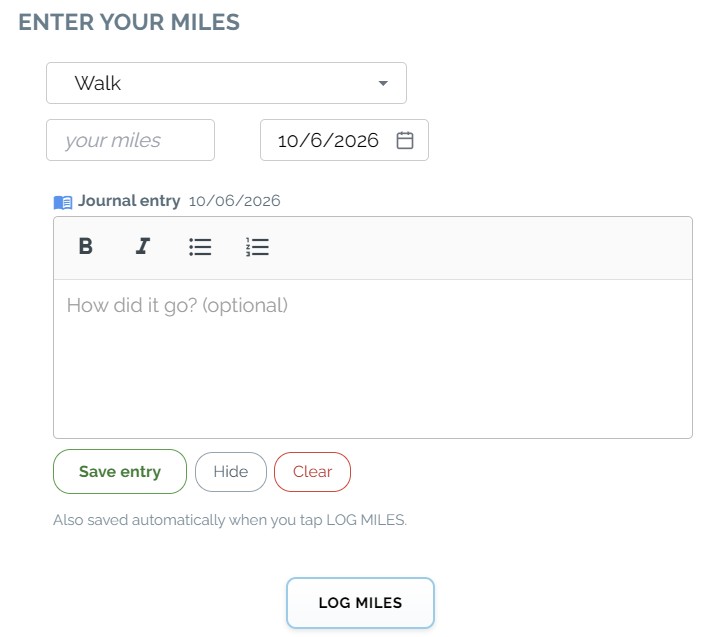
Entries are private to you in the app and never shown to other members. No admin screen displays them, and they are never sent to any AI feature. You get one entry per day, up to 5,000 characters, and you can turn the feature off in My Settings under App Options.
If a group challenge sounds appealing, Your First Challenge and Choosing Your Goal are the best next reads.